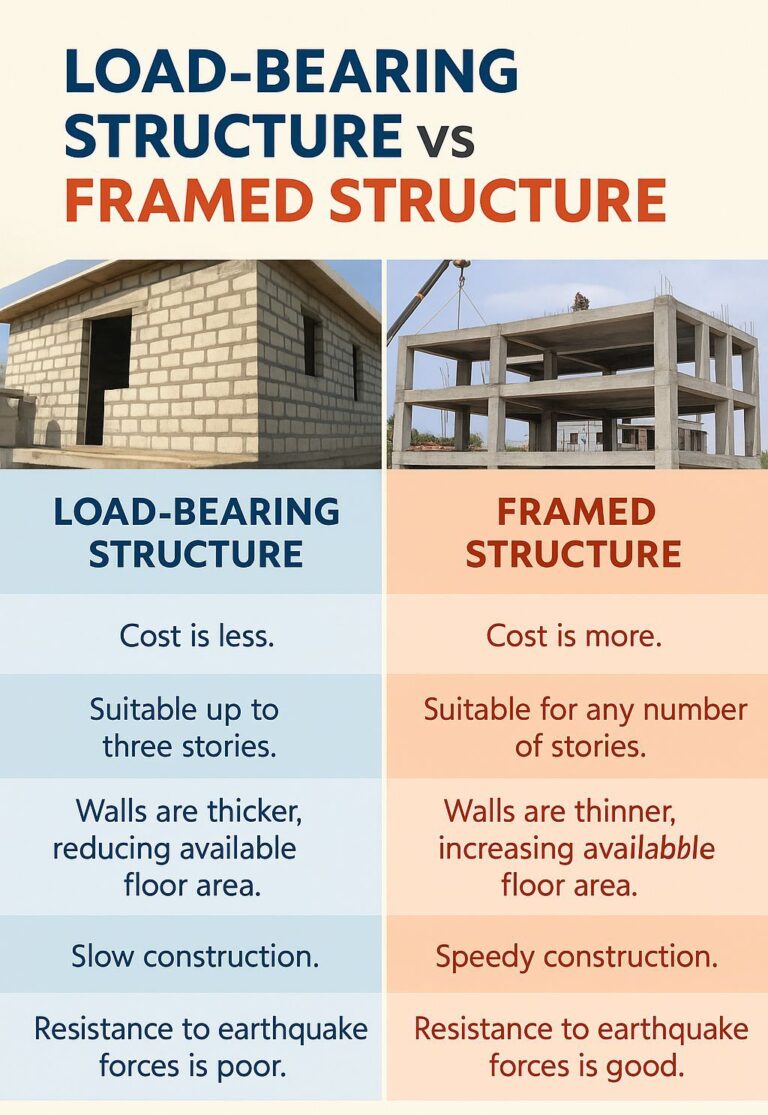
🔍 RCC vs Load Bearing Structure — Deep Comparison Every Civil Engineering Fresher Should Know
🏗️ 1. Load Transfer Mechanism
🔸 RCC (Reinforced Cement Concrete) → Slab ➡ Beam ➡ Column ➡ Footing
🧱 Load Bearing → Slab ➡ Wall ➡ Foundation
📌 RCC gives better control in load distribution and stability.
🧱 2. Structural Elements
✅ RCC: Columns, beams, slabs, footings; walls just fill space.
🏚️ Load Bearing: Thick brick/block walls take all loads.
📌 RCC offers structural freedom; Load bearing depends on walls.
💰 3. Cost Factor
📈 RCC: Higher cost (steel, concrete, skilled labor, shuttering).
📉 Load Bearing: Lower cost (more masonry, fewer RCC elements).
📌 Ideal for low-budget, G+1 village homes.
⏱️ 4. Construction Speed
🐢 RCC: Slower — curing, reinforcement, and formwork needed.
🚀 Load Bearing: Faster — mostly brickwork and slab casting.
📌 Speed is good, but quality matters more.
🧭 5. Design Flexibility
🛋️ RCC: Open layouts, big windows, easy interior changes.
🚪 Load Bearing: Limited room sizes, fewer openings, walls can’t be moved.
📌 RCC fits modern architectural needs better.
🌍 6. Earthquake Performance
💪 RCC: Safer in seismic zones due to ductility.
⚠️ Load Bearing: Brittle — not safe in earthquake-prone areas.
📌 Avoid load bearing in Zone III and above.